

If you talk to enough people who run compliance for a living – plant managers, facilities directors, food safety leads – a strange pattern starts to show up. Ask them whether their team performs all the required checks, and the answer is almost always yes, without hesitation. Ask them whether they’ve ever been fined anyway, and the answer is, just as often, also yes.
This isn’t a contradiction once you understand what regulators are actually checking for. They’re not just verifying that a task got done somewhere, at some point, by someone. They’re verifying that you can prove it, quickly and consistently.
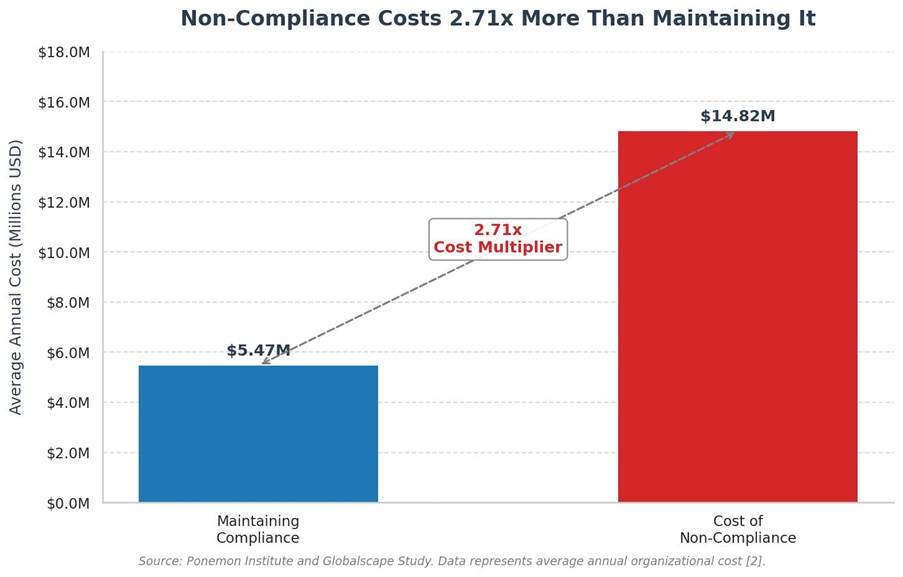
The Ponemon Institute and Globalscape study shows that non-compliance with data protection rules costs an average of $14.82 million annually, which is 2.71 times higher than the $5.47 million average cost of maintaining compliance.
And that’s exactly where most facilities fall apart. Not because the work isn’t happening, but because the proof of it is scattered across paper forms, spreadsheets, texts to a supervisor, and whatever folder someone saved a photo in six months ago. When everything lives in a different place, in a different format, on a different person’s phone or desk, there’s no way to pull it together fast enough when someone actually asks for it. What you need isn’t a stricter checklist or a more diligent team. You need one system that captures the work the moment it happens and keeps it organized automatically, so proving compliance stops being a scramble and becomes something that’s just already done.
Why Good Teams Still Fail Inspections
Here’s roughly how it plays out, and once you see it once, you start noticing it everywhere.
A technician runs a required check. Say, testing a cooling tower for Legionella risk, or logging a cold storage temperature, or completing a monthly fire suppression inspection. They do the work, then they write it down, because that’s how it’s always been done. Maybe it goes on a paper form. Maybe it gets typed into an Excel sheet later that day. Maybe it’s just a text to a supervisor saying “done, all good.”
None of that is wrong on its own. The record does exist. It’s just scattered around. Different formats, different devices, different people remembering where they put things. For a while nobody notices, because nobody’s checking.
Then an inspection gets scheduled, and someone has to go find all of it. They’re cross checking dates against a logbook, digging through a filing cabinet, trying to turn three months of activity into whatever format the regulator wants to see. If that takes too long, or one week’s record is missing because it got misfiled or never written down properly, the facility gets cited. For work that was actually done.
We’ve seen this cost water treatment operators real money in Department of Health fines. Not because the testing didn’t happen. Because proving it happened, on the spot, was never built into how the work was tracked. NYC collected roughly $600,000–$680,000 in cooling tower fines in fiscal year 2025 alone, under the old (less strict) testing law.
There’s a second version of this problem that’s quieter, and probably more common. The check that gets missed completely. Not out of laziness, but because nobody had a clear, shared view of what was due where. A team managing a dozen sites, each with its own schedule, ends up relying on someone remembering that Building C’s fire suppression check is due this week, or that a certain boiler needs checking every 30 days instead of 60. When that only lives in one person’s head, something eventually slips through. That’s a visibility problem, and it causes just as many fines.
What Regulators Actually Want to See
It helps to slow down on that point, because it changes what the real problem is. Most teams assume that if they do the work carefully, the compliance side takes care of itself. In practice, a record only counts as real proof if it meets a few basic conditions. It needs a date, a location, and a name attached to it. It can’t depend on one person remembering where they put it. And it has to be something you can pull up in minutes, not days, when someone asks for it.
That last part is where most teams get caught out. A record that technically exists but takes two days to find might as well not exist, as far as an inspector is concerned. So the thing that actually gets facilities fined usually isn’t a lack of effort. It’s that the proof of that effort is disorganized.
A Real Example. From Paper Files to a System the Health Department Praised
We built a compliance tracking system for a company that runs water treatment programs across hospitals, residential towers, and commercial buildings. The kind of setting where a missed inspection isn’t just a paperwork issue, it’s a patient safety issue.
Before we came in, their operation worked the way a lot of field heavy businesses still do. A technician would finish a service on site, and the office often wouldn’t know until the paperwork physically made it back, sometimes a day or two later. When a Department of Health audit came up, getting ready for it meant digging through paper files and hoping nothing important had gone missing. Scheduling, technician assignments, and compliance checklists all lived in separate places, so nobody could say with full confidence that any one system reflected what was actually happening at every site.
To be clear, this wasn’t a case of technicians not doing their jobs. They were. What was missing was a way to capture that work as it happened, and pull it up easily later, instead of piecing it together under pressure right before an inspection.
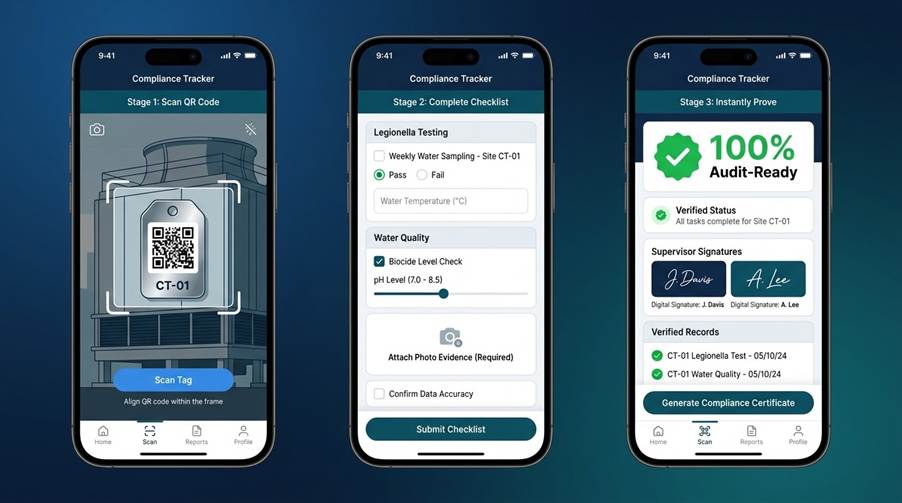
Once we rebuilt that part of the process, capturing field data on site and syncing it to the office right away, things changed fast. Every finished service now creates a standard, timestamped report on its own. Records for any facility can be pulled up by location instead of dug out of a filing cabinet. When the Department of Health looked at the new system, they said it was one of the best compliance setups they’d seen, which is a big deal in an industry that, in a lot of places, still runs on clipboards.
The simple version of what changed is this. Proof used to be something people put together after the fact. Now it gets created as the work happens, without anyone having to think about it separately.
How a Compliance App Actually Solves This
None of this means doing more compliance work. Most teams are already doing plenty. What changes is how the proof gets captured, and where it lives once it exists.
In practice, this comes down to two things. Making sure the right work happens at the right time, and making sure there’s clean proof once it does.
For the first part, the goal is that nobody has to remember what’s due where on their own. Every facility or piece of equipment gets its own checklist and schedule, set up once and then handled automatically. Technicians and managers get a reminder as something comes due, not a vague sense that “cooling tower checks happen monthly,” but an actual heads up that this specific check is due this week. And because schedules, assignments, and statuses all sit in one shared system, a manager can open one screen and see, across every site, what’s done, what’s due, and what’s about to be late.
For the second part, field staff fill out their checklist on site, in the moment, instead of from memory later that evening. This matters because that’s usually where small mistakes creep in. The office sees a finished check the second it’s submitted, instead of waiting for paperwork to physically show up. Every facility gets its own scannable code, a QR code or barcode, so an inspector can pull up the full history of certificates and reports for that site instantly, without anyone searching for anything. And because every check produces a report in the same standard, timestamped format, the records that come out are actually usable as proof, not just technically sitting somewhere in a folder.
None of these individual pieces are complicated on their own. What makes the real difference is having scheduling, reminders, field data, and reporting all connected as one system, instead of a bunch of separate habits held together by whoever happens to be paying attention that week.
What Non-Compliance Actually Costs You
The fine itself is rarely the real cost. What happens after the fine is usually worse.
A facility that gets flagged tends to get watched more closely afterward, meaning more inspections and more disruption to normal work. Contractors with a visible compliance gap tend to lose credibility during bidding, sometimes before anyone even looks at the rest of their proposal. In some industries, repeated non-compliance can lead to something bigger than a fine, like a suspended license, permit, or occupancy certificate. And there’s a quieter cost too. Clients evaluating a vendor often judge how organized that vendor is by how clean their compliance process looks, long before price or scope come up.
The facilities that never run into this problem generally aren’t working harder than everyone else. They’ve just set things up so the proof happens on its own, as part of the work itself, instead of being something someone scrambles to put together the night before an inspector shows up.
Who Actually Needs This The Most
This problem shows up anywhere regulated work happens away from a desk, and where the people doing the work aren’t the ones who have to answer for it later. Water treatment and industrial systems are one clear example, with Legionella testing, boiler checks, and closed loop system inspections. Healthcare facilities deal with a version of this around equipment checks and environmental monitoring. Food service operators run into it with temperature logs and sanitation checklists tied to health department reporting. Fire and life safety teams deal with it through suppression system and alarm testing. HVAC teams see it in maintenance schedules and refrigerant handling records. Elevator operators face some of the strictest inspection schedules out there, with paperwork to match.
The regulators are different, the checklists are different, but underneath it’s usually the same problem. And the same fix.
Quick Check. Is This Your Facility?
A few simple questions tend to surface this fast. If an inspector showed up today and asked for the last six months of records for one site, could someone actually find that in under two minutes? Does your office find out a check is done the moment it happens, or only once the paperwork physically shows up? If the one person who normally handles filing these records was out sick that week, would anything go missing or get delayed?
If any of those made you pause, the work itself is probably fine. It’s the proof that isn’t set up to hold under pressure yet. And that part is fixable.
Want To Fix This For Your Team?
If your team is still tracking compliance through spreadsheets, shared drives, or paper logs, and inspections feel like a scramble even when the work actually got done, that’s usually a sign the process needs to be digitized. Not that the team needs to work harder.
In practice, that looks like a custom app that keeps everyone, field staff, supervisors, and managers, on the same page. Everyone can see what’s due and where, reminders go out before something’s overdue instead of after, and the records that come out the other end are already organized enough to hand an inspector without a scramble.
We’d be glad to walk you through what a system like this could look like for your specific facility type and regulatory requirements. Book a free consultation today.

 For business inquiries
 For jobs inquiries